In recent days, a letter sent anonymously from a children’s hospital has captured the attention of millions. Shared across social media platforms, it has drawn tears from fans and strangers alike. The letter was simple, handwritten on a sheet of plain stationery, and addressed to one man whose name is usually tied to country music, guitar strings, and sold-out arenas — Alan Jackson.
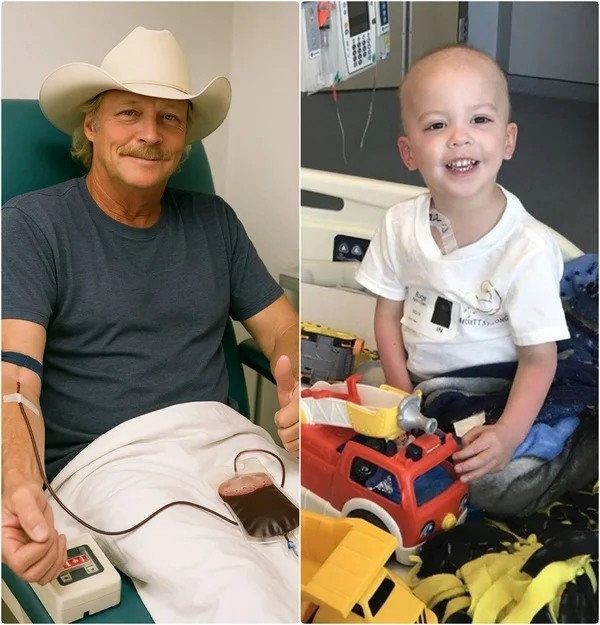
But this wasn’t fan mail. It wasn’t a request for an autograph or a declaration of love for his songs. This letter revealed something few ever knew: for the past five years, Alan Jackson has been quietly donating blood nearly a hundred times to children fighting cancer. And because of his rare blood type, those donations carried the difference between despair and hope for countless families.
The letter began with a sentence that instantly tugged at the world’s heart:
“You don’t know my name, but my son is alive today because of you.”
A Different Kind of Stage
Alan Jackson has long been known as one of country music’s most enduring voices. His songs — “Remember When,” “Chattahoochee,” “Where Were You (When the World Stopped Turning)” — carry the essence of storytelling that touches generations. Fans often imagine him under the spotlight, surrounded by roaring crowds, pouring his heart into lyrics about love, loss, and faith.
But according to hospital staff who later confirmed the story, another stage has defined his life away from music: a quiet hospital donation room where Alan has been walking in without press or photographers, rolling up his sleeve, and giving what he calls “the simplest gift God allowed us to share.”
A nurse who wished to remain anonymous shared, “He always came in humble, no entourage, no fuss. Sometimes he’d bring cookies for the kids or chat with the staff. And then he’d just quietly sit down, donate, and leave. It was never about recognition. It was about the children.”
The Rare Blood Type
What makes Alan’s effort even more extraordinary is his rare blood type. In medical circles, such blood types are referred to as “lifelines” because they are scarce yet critically needed. For children undergoing chemotherapy or bone marrow transplants, receiving compatible blood can mean the difference between life and death.
Doctors noted that Alan’s contributions weren’t symbolic — they were lifesaving. “In the past five years, his donations were used in multiple transfusions for children who would otherwise not have had a match,” one pediatric oncologist said. “It’s one thing to give money. It’s another to give of yourself, literally.”
And yet, Alan never publicized this. No press releases, no foundation names, no social media announcements. For years, it was his private mission, known only to hospital staff and the families whose lives he touched.
The Letter That Changed Everything
The reason the world now knows lies in that anonymous letter. The parent of a child who had survived thanks to Alan’s blood decided it was time to lift the veil on his hidden kindness. They wrote:
“Every time my daughter needed a transfusion, the doctors would say: ‘We’re lucky — we found a match.’ We didn’t know who it came from until one day, a nurse whispered: ‘It’s Alan Jackson.’ I couldn’t believe it. This man who sings about simple love and faith was also quietly saving lives. I don’t think he’ll ever understand the depth of what he’s done for families like mine.”

When the letter made its way online, it spread like wildfire. Fans shared it with captions like “true hero,” “country music’s angel,” and “a legacy bigger than music.”
Alan’s Response
For days, Alan remained silent as the story swirled around him. Finally, he addressed it during a quiet moment at a small benefit concert in Tennessee.
He stood on stage, holding his guitar, and spoke softly:
“I never wanted anyone to know because it wasn’t about me. God gave me this voice for music, and I thank Him for that. But He also gave me a blood type that could help others, and it felt wrong not to share it. I didn’t do anything extraordinary. I just did what I could. And if those children can grow up, chase their dreams, and live full lives, then I think that’s the greatest song I’ll ever be a part of.”
The audience rose in applause, many in tears. It wasn’t just about the music anymore. It was about a man who embodied the very values his songs carried: humility, faith, family, and giving.
Fans React
The revelation sparked an outpouring of gratitude across the world. Fans flooded social media with messages like:
- “Alan Jackson taught us that heroes don’t wear capes; sometimes, they just roll up their sleeves.”
- “His songs healed our hearts, and now we know his blood healed lives.”
- “This makes me love him even more than before. What a man.”
Many fans were inspired to register as blood donors themselves. Blood centers in Nashville reported a surge in first-time donors, many of whom specifically cited Alan Jackson’s story as their motivation.
The Ripple Effect
The most powerful impact of Alan’s hidden generosity might not just be the children he directly helped, but the thousands of people now stepping forward to donate because of him. Hospitals noted that while celebrities often raise awareness through campaigns, very few take the personal, repeated action that Alan did.
In fact, blood donation organizations have already launched initiatives in his honor, calling them “The Alan Jackson Challenge,” urging people to donate not once, but consistently, as he did.
A Legacy Beyond Music
Alan Jackson’s career has always been about more than just the charts. His songs hold stories that connect deeply with everyday people — from falling in love in small towns to grappling with grief and faith. Yet this newly uncovered chapter shows that his greatest story may not be written in music, but in the lives he touched silently.
It reminds the world that legacy is not only about fame or accolades. True legacy is about the lives you lift, the hope you give, and the love you share when no one is watching.
Alan himself summarized it best when asked later in an interview if he would continue donating:
“As long as the Lord keeps me healthy, I’ll keep showing up. These kids are the real fighters. I’m just a guy trying to help them win.”

The Eternal Song
There’s something poetic about the fact that Alan Jackson — a man whose music often circles back to themes of faith, resilience, and love — has been living those themes in silence. In giving his blood nearly a hundred times, he has, in a very literal way, given his life to others piece by piece.
It’s a reminder that kindness doesn’t need an audience. Compassion doesn’t need a microphone. And sometimes, the most powerful songs are the ones you’ll never hear on the radio, but will echo in the lives of those who were saved.